
Egypt’s 365-day calendar drifts off the seasons
With no leap day, Egypt’s civil year ran nearly a quarter-day short of the sun, so its ‘Inundation’ season only occasionally matched the Nile flood. A leap-day fix in 238 BC was abandoned.
462 entries · 2510 BC to 2026 · 152 of them fixes
4,500 years of wrong numbers, lost records and units nobody checked, and the inventions that caught them.

California drawn as an island, a mapping error copied for over a century (about 1650, Library of Congress) · Johannes Vingboons · Public domain
Before 1450
5 entries
With no leap day, Egypt’s civil year ran nearly a quarter-day short of the sun, so its ‘Inundation’ season only occasionally matched the Nile flood. A leap-day fix in 238 BC was abandoned.
Most scholars find six wrong numbers in Plimpton 322, a Babylonian table of right-triangle values. One is a 9 copied where an 8 belonged; another is the square of the right value.
Rome’s calendar stayed in step with the sun only if extra months were inserted, and that wasn’t always done. Events Livy dated show it four months off in 190 BC, two in 168 BC.
Caesar made 46 BC, the ‘last year of confusion’, 445 days long to make up for skipped leap months. His new calendar was meant to stay aligned with the sun with no human intervention.
Rome’s priests misapplied Caesar’s new rule and added a leap day every three years: twelve in thirty-six years instead of nine. Augustus had to skip leap years, and dates before 8 BC remain uncertain.
Julian calendar § Leap year error; also Ancient Egyptian calendar
10 entries
Andean peoples, and later the Inca, kept tax and census records on knotted cords. One cord often held the sum of the cords after it, so totals were built into the record.

Luke dates Jesus’s birth to a census held in AD 6 and also to Herod the Great’s reign, though Herod died earlier. Most critical scholars say Luke got it wrong.
Ptolemy’s atlas of about 150 AD listed coordinates for thousands of places, but its longitudes are systematically too large, by a factor of 1.428. His world map comes out stretched, Italy most visibly.
A copyist split the Latin name Mathathiae into separate names, turning one person into a pair. The family tree of Jesus in the Book of Kells gained an ancestor who never existed.
Adding up a number’s digits gives a fast check on a sum, first described by Aryabhata II around 950. Its blind spot: swapped digits, like 1324 for 1234, slip through.
Roman numerals caused countless mistakes in William the Conqueror’s Great Survey of England. More serious still are its many obvious gaps and ambiguous entries.
Clause 35 of Magna Carta set a single measure for wine, ale and corn across England, the London quart, plus one standard cloth width, so a quantity meant the same everywhere.
Recording each transaction twice lets mistakes and fraud show up when the books disagree. A Florentine ledger from 1299–1300 is the earliest surviving example of the full method.
Mayda, an island that isn’t there, first showed up on a chart in 1367. Mapmakers kept copying it, and a relief map from 1906 still included it.
Las Casses Bank, a reported hazard between Menorca and Sardinia, was not real. Cautious chartmakers kept it anyway, from 1373 until as late as 1852.
1450 to 1799
2 entries
Columbus read a figure given in long Arabic miles as shorter Roman miles. His Earth came out about 25% too small, and Spanish experts said he had the distance to Asia far too short.

Christopher Columbus § Geographical considerations; also Unit of measurement
Pacioli’s 1494 textbook set out double-entry bookkeeping and proposed a trial balance to prove the ledger was right. His advice: don’t sleep until debits equal credits.

4 entries
St Matthew Island, said to be found in 1516, stayed on charts into the twentieth century. Writers later suggested a mix-up with Annobón, which shares its latitude.
Explorers reported the Los Jardines islands in 1528 and 1542, and a captain sighted them again in 1788. They were phantoms, yet official charts kept them until 1973.
Bermeja, listed in 1539 and charted off Yucatán for centuries, could have extended Mexico’s oil rights. Surveys in 1997 and 2009 found nothing; an early mistaken sighting is one explanation.
A scribe wrote Java where Marco Polo’s route meant Champa, shifting a land 1,300 miles out of place. Mercator, on his 1541 globe, and others drew it on a southern continent.
5 entries
The Julian calendar counted 365.25 days a year, slightly more than reality, so it drifted over centuries and threw off the date of Easter. Pope Gregory XIII’s 1582 reform corrected it.

In 1553 Hugh Willoughby reported islands that later explorers couldn’t find. A false 1612 claim that they were Spitsbergen then helped justify a 1613 whaling monopoly.
Frisland appeared on nearly every North Atlantic map from the 1560s to the 1660s. With poor navigation tools, sailors may have mistaken the Faroes, Iceland or Greenland for it.
A 1562 Bible blessed the ‘placemakers’ instead of the ‘peacemakers’, and a chapter heading said Christ condemned the poor widow when he actually praised her.
Returning from Frobisher’s 1578 voyage, a ship probably misjudged its estimated position and mistook optical effects for land. The resulting Buss Island stayed on charts until 1818.
6 entries
A 1631 Bible dropped the word ‘not’ from the commandment against adultery. The royal printers were fined £300 and lost their licence to print.

London’s weekly death records counted only Church of England burials inside fixed parish lines, leaving out other faiths and outlying cemeteries. About a third of deaths went unrecorded.
From 1603, maps showed California as an island. Mapmakers copied each other, so the error spread despite explorers’ reports, until expeditions in 1774–1776 settled it.
A 1613 Bible put Judas in place of Jesus in Matthew 26:36. One surviving copy hides the mistake under a scrap of paper pasted on top.
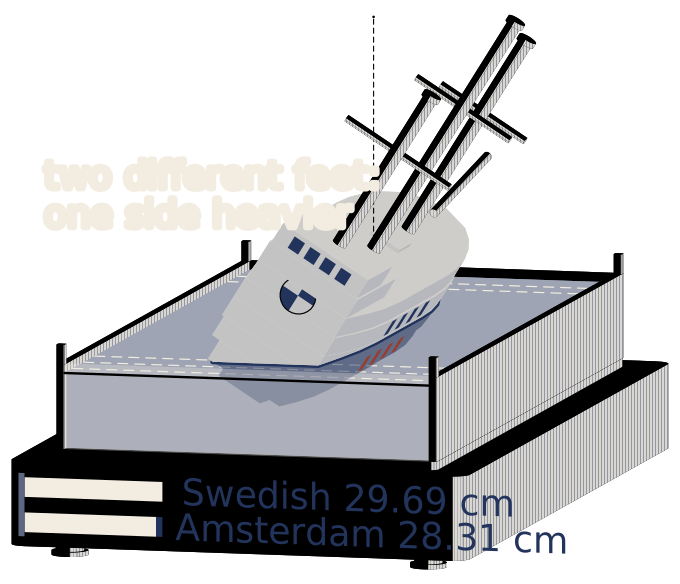
Vasa’s builders measured in two feet, Swedish and the shorter Amsterdam foot, so she came out heavier to port. Already unstable, she heeled in a 1628 gust and her open gunports went under.
With rival calendars in use, the same day had different dates. Letters on trade and diplomacy often gave both, like ‘12/22 Dec. 1635’, so nobody misread which day was meant.
3 entries
Pennsylvania’s 1681 charter was drawn from a faulty map. The border it described, the 40th parallel, actually lies north of Philadelphia, which sparked a long dispute with Maryland.
In 1683 a corsair reported a new island at 47°S, now thought to be the Falklands misidentified. Expeditions spent the next century looking for it in vain.
Pirate Edward Davis reported land in 1687, probably small islands already known. Navigators were told to seek it, and a French voyage in 1767 set out partly to find it.
7 entries
Ships could not pin down their longitude, their east-west position. Britain’s 1714 Longitude Act offered a prize for a practical way to measure it precisely.

Sweden tried to switch calendars slowly by skipping leap days, but war got in the way and some were kept. Matching neither calendar, it went back in 1712 by adding February 30.
List of non-standard dates § February 30; also Swedish calendar
Named Cloates Island in 1719, the point was confused with other features and mismapped. A 1785 world map put it more than 1,600 km away; it was later shown to be a peninsula.
Sailors kept reporting Aitkins’ Rock off Ireland from 1740, and it was blamed for many lost ships. A long 1840 survey concluded it was never there; debris or whales were likely seen.
A 1744 map probably drew Isle Royale twice under different names. The copy, Isle Phelipeaux, spread to later maps and was used to mark a border by the Treaty of Paris in 1783.
Extending the Virginia–North Carolina line in 1749, surveyors didn’t allow for shifts in magnetic north and drifted almost five miles north. Border arguments in the area ran until an 1893 Supreme Court ruling.
13 entries
The 1799 metre, set from a survey of the Paris meridian, is about 0.2 mm shorter than intended. Most of the gap comes from local gravity tilting plumb lines, which nobody had studied yet.

Arc measurement of Delambre and Méchain; also Metre Convention
England’s legal year began on 25 March, while most of Europe and Scotland used 1 January, confusing merchants and diplomats. The 1750 Act moved the start to 1 January.
Trusted authors described a large lake near Chiang Mai that wasn’t there. Mapmakers kept copying it until 1751, and it made the first Encyclopaedia Britannica.
Johnson’s 1755 dictionary defined the pastern as a horse’s knee, though it’s actually the part of the leg below the fetlock. Asked why, he blamed pure ignorance.
A Dictionary of the English Language § Criticism; also Lexicographic error
A 1755 map that stretched the Mississippi up to the 50th parallel was used to set US borders in 1783. Its errors led to disputes and one impossible boundary.
A 1763 Bible printed Psalm 14:1 as saying there is a God, dropping the word ‘no’. The printers paid a £3,000 fine and every copy was ordered destroyed.
Mason and Dixon’s 1763–1767 survey kept drifting the same way, an error that leans one direction rather than at random. Cavendish suspected the mountains’ gravity was pulling their plumb-bobs.
Mason–Dixon line § Systematic errors and experiments to weigh the Earth
Negotiators in 1783 used a map that drew Lake of the Woods as an oval and missed the Mississippi’s source. The border they wrote left the Northwest Angle cut off from Minnesota.
The 1788 survey of New York’s Preemption Line used defective methods and leaned about 2° off true north. New York wrongly granted land in the strip, including Geneva, until a 1792 resurvey.
Records for Delaware, Georgia, New Jersey, Virginia and other states were lost by 1830. Almost a third of the original 1790 census data no longer exists.
Jefferson and Washington believed the 1790 census undercounted. Possible reasons: a spread-out population, poor transport, limited technology and some people refusing to take part.
Many French length units were set by the size of body parts. In 1791 France swapped them for one decimal standard, the ancestor of today’s international units (SI).
Rennell’s 1798 map drew a mountain range across West Africa to back his theory of the Niger. The range didn’t exist, but mapmakers copied it until the late 1880s.
1800 to 1939
15 entries
Hand-calculated maths tables were full of errors, many from typesetting slips. Babbage’s 1822 difference engine would compute the tables and send results straight to print.

A proofreader wrote ‘to remain’ beside the text to say a comma should stay. The printer set the note into Galatians 4:29 as if it were holy text.
Every measurement carries small errors. Legendre’s 1805 method of least squares finds the best fit through noisy data, and Gauss in 1809 linked it to the probability of errors.
In 1808 the Edinburgh Review printed ‘kimes’ when it meant ‘knives’. The fake word circulated for a while, and Skeat later cited it when naming ‘ghost words’.
An inaccurate 1770s survey of the 45th parallel led the US to build a fort north of the real border. An 1842 treaty kept the old line, so the fort stayed American.
Surveyors in 1818, reportedly using outdated instruments, put the 35th parallel 1 mile south of its true line. Georgia has challenged the border many times since, seeking a stretch of the Tennessee River.
An 1820 dictionary dropped the hyphen from Pope’s ‘Phantome-nations’ and listed ‘Phantomnation’ as a real word. Later dictionaries copied the mistake.
A ship reported Emerald Island south of New Zealand in 1821, but searches in 1840 and 1909 found nothing. It still appeared in a 1987 atlas from American Express.
Captain Benjamin Morrell recorded land he called New South Greenland in 1823. An explorer found nothing there in 1912; Morrell may have miscalculated where his ship was.
The leading map put Lake Michigan’s southern tip too far north, so Ohio and Michigan read their border differently. Both claimed a 468-square-mile strip, ending in the 1835 Toledo War.
An 1836 fire at the US Patent Office destroyed records of around 9,957 patents, and only 2,845 came back. Afterwards patents got numbers and documents had to be filed in multiple copies.
With inadequate equipment, a surveyor in 1839 placed the start of the 141st meridian border about 2 miles off. After a 75-year fight, South Australia lost over 1,300 km2.
The Royal Company’s Islands, reported south-west of Tasmania, were shown not to exist by 1840. Britain’s chart office only took them off every Admiralty chart in 1904.
Counting burials gave London poor death figures. From 1840 the weekly numbers came from death certificates instead, through the Registrar General’s returns, and were much more accurate.
Dougherty Island, first reported in 1841, stayed on maps until 1934 though no island was ever found. Observers were most likely fooled by icebergs or banks of fog.
16 entries
In 1876 a whaler reported an island near New Caledonia, possibly a raft of floating pumice. France dropped it in 1974, but it stayed in global coastline data and on Google Maps until 2012.

One wild measurement can skew a whole result. In 1852 Benjamin Peirce offered the earliest significance test for deciding whether such an outlier should be discarded.
Missionaries who never left the coast exaggerated reports of one great lake and mapped a huge inland sea in 1855. Burton and Speke went to look and found separate lakes.
Sarah Ann Island, claimed in 1858, couldn’t be found in 1932 or 1937. It may be Malden Island, logged by a clerical error at 4° N when it sits at 4° S.
Charles Babbage was asked whether his machine would give right answers if fed wrong figures. The principle behind the question is now known as garbage in, garbage out.
New York and Philadelphia complained the 1870 census missed as much as a third of residents, so the President ordered a recount. It raised their populations by only 2% and 2.5%.
A popular story blames a misplaced decimal for an 1870 figure that made spinach look ten times richer in iron. The real error was in the measurement itself, corrected in the 1930s.

In 1871 fires destroyed nearly 11,500 Paris parish and civil registers holding over 8 million documents, even though they were kept at two sites. The gap is permanent.
Countries were measuring with standards that didn’t match. In 1875, 17 states signed the Metre Convention, creating bodies to define and maintain common units.
Schiaparelli called the lines he saw on Mars ‘canali’, meaning channels. Rendered in English as ‘canals’, the word suggested built waterways, helped along by blurry telescopes and optical illusions.
In 1881 Simon Newcomb noticed log-table pages for numbers starting with 1 were the most worn. The pattern, restated by Benford in 1938, has since been tried as a test for made-up figures.
Appletons’ Cyclopædia of American Biography was trusted for decades, yet it held at least 144 biographies of people who never existed. The first fakes were exposed in 1919.
The 1890 rough count of 62,947,714 met public disbelief. Statisticians argued it missed one to several million people, most likely young children, African Americans and working-class people.
Peary mapped a channel across north Greenland from what he saw in 1892. In 1907 an expedition leader searched for it and died, misled by the map; confirming the error took twenty years.
America’s lengths and masses rested on England’s customary standards. In 1893 the Mendenhall Order switched the country’s base standards over to metric ones.
Census maps and many state road maps put Elm Point in one county, but another county collects its property taxes. The mix-up seems to come from how an 1896 proclamation was worded.
8 entries
Early weight calculations for the Quebec Bridge were never properly checked. The bridge proved far heavier than it could carry, and in 1907 it collapsed, killing 75 of 86 workers.

A clerical error put 50,000 new railroad shares on sale before they were listed. John Warne Gates bought a majority and sold it to J. P. Morgan at a big profit.
In 1903 Blondlot announced N-rays, and about 120 other scientists claimed to detect them. Leading physicists couldn’t repeat the results, and the rays turned out to be imaginary.
A 1903 music dictionary ended with ‘zzxjoanw’, said to be a Māori word for drum. Word enthusiasts repeated it for decades until it was flagged as a likely hoax in 1976.
Peary claimed he saw Crocker Land in 1906, but his own diary said no land was visible. The 1913 expedition sent to find it ended up following a mirage.
In 1906 Walter Kaufmann said his measurements contradicted special relativity. It took a decade to see the flaws in his test, and meanwhile critics used it against the theory.
List of experimental errors and frauds in physics § Famous experimental errors
In 1907 explorers recorded land off north-east Greenland. It was really a mirage of nearby Tobias Island, which was only confirmed in 1993.
In 1908 Japan annexed an island it matched to charted Ganges Island, even though the positions didn’t line up. Nobody ever found it, and it was declared non-existent in 1946.
2 entries
A leading Japanese-English dictionary translated kusege, frizzy hair, as ‘vicious hair’ from 1918 to 1974. Generations of users copied the error before it was fixed in 2003.
The same surname can be spelled many ways. Soundex, patented in 1918, gives similar-sounding names one code, and a version was used to index US censuses from 1890 to 1920.
7 entries
Every process wobbles a little. Shewhart’s 1924 control chart separates that chance variation from real, traceable causes worth investigating, the start of statistical process control.

Walter A. Shewhart § Work on industrial quality; also Statistical process control, Control chart
A 1921 fire damaged the bulk of the 1890 census records, and the government destroyed what was left by 1935. The loss fuelled calls for a National Archives.
Steering by estimate in fog, the lead navigator dismissed new radio bearings as unreliable. They were right. Seven destroyers ran aground at Honda Point in 1923, and twenty-three sailors died.
Walter Adams’s 1924 measurement seemed to settle gravitational redshift, but the prediction and the measurement were both wrong. Stray light from the star Sirius A may have polluted his readings.
List of experimental errors and frauds in physics § Famous experimental errors
Mapmakers invented Agloe, New York, to catch copiers. A cartographer later said it turned up on a rival’s map, whose makers claimed county records listed a business named Agloe.

Filippo Reef rests on an old ship’s report and an unnamed 1926 report of breakers, but the sea there is 5.3 km deep. The reef is likely a phantom, yet a 2015 atlas marked it.
Emil Rupp was seen as a top experimenter of his era, until he had to admit his record, including 1926 experiments, rested partly on fabricated results.
List of experimental errors and frauds in physics § Alleged scientific misconduct cases
2 entries
The Literary Digest polled its readers, car owners and phone users, all richer than average, and Roosevelt’s critics replied more. It gave Landon 57.08% and missed the winning margin by 39.08 points. The magazine folded.

The Literary Digest § Presidential poll; also Sampling bias, Opinion poll
A note meaning ‘D or d’, for density, was read as one word, and ‘dord’ entered Webster’s in 1934. Proofreaders missed it until 1939, when an editor saw it had no word origin.
1940 to 1979
6 entries
The Chicago Tribune’s 1948 headline trusted a phone survey, when phone users weren’t typical voters, plus a Gallup poll over two weeks old. Truman beat Dewey.
Sampling bias § Historical examples; also Opinion poll, Dewey Defeats Truman
A 1944 Bible was printed from a plate whose letter n was damaged, so it came out as an l. As a result 1 Peter 3:5 refers to wives’ ‘owl husbands’.
One person’s details end up scattered across many files. In 1946 Halbert Dunn proposed record linkage: joining the records that describe the same individual.
Every channel adds noise that garbles messages. Claude Shannon’s 1948 paper founded information theory and set the top rate at which data can still be sent reliably.
A Mathematical Theory of Communication; also Error detection and correction
Signals sent across space arrive with errors. Marcel Golay’s 1949 codes can correct them, and were later used to send Voyager’s colour images of Jupiter and Saturn.
17 entries
Punched card readers kept introducing errors. In 1950 Richard Hamming invented codes that add a few check bits, so a computer can pinpoint a wrong bit and correct it.

Frank Grubbs’s 1950 test checks whether the value furthest from the average is an outlier, catching one suspect value at a time.
A lab test can drift without anyone noticing. In 1950 Levey and Jennings had labs plot a known sample every day, so a drift or a jump in random error shows up on the chart.
A second operator re-typed each punched card and a machine flagged any mismatch. It caught random slips of the finger, though not errors in reading the source document.
From 1950 W. Edwards Deming taught Japanese industry leaders to manage product quality with statistics. Many in Japan see him as one inspiration for the post-war economic miracle.
From 1951, data stored on magnetic tape carried a parity track: an extra bit per row, so a single flipped bit shows up as a mismatch.
A small, steady shift hides inside normal noise. In 1954 E. S. Page’s CUSUM chart added up the gaps from target, so a quiet drift builds into a clear signal to act.
People mistype ID numbers. Hans Peter Luhn’s 1954 check-digit formula lets a computer spot every single-digit error and almost all swaps of neighbouring digits.
Luhn algorithm; also Check digit
Signals pick up errors along the way. Peter Elias’s 1955 convolutional codes correct them, and were later used in GSM mobile phones.
People reading the same chart could disagree on whether something was wrong. Western Electric’s 1956 rules gave everyone the same tests for a real problem versus chance.
A 1957 newspaper story on Army mathematicians told readers that computers can’t think for themselves, so careless inputs lead to wrong outputs.
Windscale’s temperature sensors sat where the design expected heat, not where the core actually got hottest. Hot spots went unseen before the 1957 fire.
In fog, the crew read their three-needle altimeter as showing 11,500 feet, but they were really at 1,500. 9 people died, and Britain ordered that kind of altimeter replaced.
Transmitted data picks up errors. BCH codes, invented in 1959 by Alexis Hocquenghem and in 1960 by Bose and Ray-Chaudhuri, let receivers detect and correct them.
When matching records, sharing a common value means less than sharing a rare one. Howard Newcombe’s 1959 paper gave record linkage this probability-based weighting.
An Electra crashed into New York’s East River in 1959, killing 65. Factors included one wrongly set altimeter and the crew likely misreading the unfamiliar new-style dial.
In 1959 six English-speaking nations agreed on one definition: the yard is exactly 0.9144 metres and the pound exactly 0.45359237 kilograms, so their measures match.
22 entries
A bar marking an average was left out of Mariner 1’s hand-written guidance equations, so software used unsmoothed values. Together with a hardware fault, the rocket veered and was destroyed.
$18.5 million

Every sensor reading carries some noise. Kalman’s 1960 filter combines readings over time into one estimate that is usually closer to the truth than any single reading.
Robert Gallager’s 1960 codes could correct errors in transmitted data, but decoding them took more computing power than the hardware of the day had, so they were largely ignored.
In 1960 an early-warning radar in Greenland took the Moon rising over Norway for a big Soviet missile launch, and NORAD was put on high alert.
From the early 1960s, factories began checking that the material measured going in balanced what came out, a way to find and remove badly wrong measurements.
Reed and Solomon’s 1960 codes add extra information so errors in data can be corrected. Voyager used them from 1977, and the compact disc from 1982.
Different fields had built up inconsistent sets of units that didn’t fit together. In 1960 the SI, today’s shared international units, was adopted to give everyone one system.
Messages can get corrupted in transit. In 1961 W. Wesley Peterson proposed tacking a short check value of fixed length onto each one, the cyclic redundancy check, so networks can detect errors.
On John Glenn’s 1962 orbital flight, a sensor reported the heat shield was no longer locked. Controllers debated the reentry plan, but the culprit was a faulty sensor switch.
Machines needed to agree on which code meant which character. ASCII, proposed by Bob Bemer in 1961 and first published in 1963, gave them a shared standard.
Time signals around the world needed to agree. Coordination started on 1 January 1960, and Coordinated Universal Time (UTC) became an official standard in 1963.
Flying through cloud in 1963, the A-12’s pitot tube, the probe that measures airspeed, iced up. The gauge read wrong, and the jet pitched up and stalled.
During the 1965 north-eastern blackout, several detectors meant to tell ordinary outages from nuclear blasts malfunctioned. Their false signals looked like an attack, and emergency planners went on full alert.
Nuclear close calls § 1965: U.S. false alarm from blackout computer errors
A programmer entered Earth’s spin as exactly 360° a day rather than 360.98°. Gemini 5 splashed down 80 miles short of its target in 1965.
Typos stop records from matching exactly. Levenshtein’s 1965 edit distance counts the insertions, deletions and substitutions between strings, so near-matches can be found.
In 1967 a solar flare interfered with NORAD’s early-warning radars. Officials first read it as deliberate Soviet jamming, and the US came close to launching a bomber counterstrike.
In 1967 Andrew Viterbi showed how to recover the most likely original message from error-correcting codes without an impossible amount of computing.
A faulty fuel gauge meant the spy plane known as Article 125 ran dry 70 miles short of Groom Dry Lake in 1967. Its pilot, Walter Ray, ejected and was killed.
From 1968, regular expressions let a program describe the shape text should have. They became a common way to catch typed input in the wrong format.
Record matching can go wrong both ways. Fellegi and Sunter’s 1969 theory scores each pair: clear matches and non-matches are decided automatically, and unclear ones go to a person.
Jacobus Verhoeff’s 1969 check digit was the first decimal one to catch every single-digit mistake and every swap of two neighbouring digits, a feat then thought impossible.
Faulty sensors and take-off figures worked out from wrong information left the plane over 5,000 pounds too heavy for the conditions. All 84 aboard and 71 on the ground died.
155 killed
19 entries
Edgar Codd’s 1970 relational model put data in tables with rules, such as that every row’s primary key, its unique ID, must never be empty.

Edgar F. Codd § Work; also Database normalization, Entity integrity
Book numbers are easy to mistype. The 10-digit ISBN, published as ISO 2108 in 1970, ends with a check digit worked out from the others, so errors can be caught.
Names get spelled differently from record to record. New York’s 1970 NYSIIS code groups similar-sounding names, about 2.7% more accurately than Soundex.
John Tukey’s 1970 box plot sums up a data set as a box with whiskers, and draws values far from the rest as separate dots, so they’re easy to spot.
A 1973 recheck by the Census Bureau estimated the 1970 census had missed about 5.33 million people, a net undercount of 2.5%.
People had no way to correct errors in credit reports about them. The 1970 Fair Credit Reporting Act let them view such records and dispute what was wrong.
Storing the same fact in several places invites contradictions when one copy changes. Codd’s normal forms from 1971, plus Boyce–Codd in 1974, shape tables to avoid these update anomalies.
In 1971 Ralph Gorin wrote SPELL at Stanford. It checked words against a list and suggested fixes for one-letter slips and swapped neighbouring letters.
The jet’s instruments very likely showed more speed than it had, so the crew slowed to about 270–275 km/h. It banked, landed hard at Irkutsk in 1971, and 97 died.
The crew were wrongly told they had 9,500 feet of runway, 1,000 feet more than existed, and used incorrect take-off speeds. The jet hit structures past the end; 29 were injured.
Exact atomic seconds and Earth’s rotation don’t line up perfectly. Since 1972, leap seconds keep UTC in sync, and 27 have been added so far.
Automated systems were storing more and more personal data. A 1973 US report proposed fair information practices, including people’s right to check that data and dispute its accuracy.
A 1973 fire at the US military records centre destroyed some 16 to 18 million personnel files. None had copies or microfilm, and no index showed which were lost.
After take-off from Sverdlovsk in 1973, an electrical failure made the artificial horizon and compass give wrong readings. The pilots lost their sense of orientation, and all 108 aboard died.
Approaching Moscow in 1973, the jet’s compass, artificial horizon and other navigation instruments failed. Correcting a small turn, the crew rolled into a 70° bank, and all 122 died.
In 1974 Cerf and Kahn described TCP, now one of the internet’s main protocols. Each packet carries a checksum, and one that arrives corrupted is treated as lost and sent again.
In 1974 a pack of Wrigley’s gum became the first barcode-marked item scanned at a checkout. The code’s last digit is a check digit that catches some scanning or typing errors.

The crew didn’t switch on pitot heat, so ice blocked the airspeed probes and the readings went wrong. Reacting to them, they stalled the Boeing 727 in 1974; all three died.
3 killed
15 entries
A control panel light showed only whether the relief valve was powered, not whether it was shut. Operators assumed it was closed while it stuck open, contributing to the 1979 partial meltdown.

Bulgaria’s ID number stores only two digits of the birth year. From 1975 it added 40 to the month for people born from 2000, and 20 for anyone born before 1900.
Store a missing value as 0 and it looks like a real count. In 1975 E. F. Codd proposed null, a marker that means no value at all, so unknown is never mistaken for zero.
The ISSN, an ID for magazines and other serials that became standard ISO 3297 in 1975, ends in a check digit so a mistyped number can be caught.
TOPS-10 stored dates in a 12-bit field whose largest value meant 4 January 1975. The next day it overflowed, and the fix borrowed spare bits other software already used.
Time formatting and storage bugs § Year 1975; also Year 2000 problem
Congress’s 1975 Metric Conversion Act set up a board to steer a voluntary switch to metric. People resisted, the board lacked power, and it was shut down in 1982.
Metric Conversion Act; also Metrication in the United States
Survey answers come back with impossible or missing values. Fellegi and Holt’s 1976 method lets a computer check records against edit rules and fill in faulty values automatically.
In 1976 Fermilab data seemed to reveal an unknown particle near 6 GeV. More data showed the bump was just random noise.
List of experimental errors and frauds in physics § Famous experimental errors
In 1976 the artificial horizon failed in poor visibility, and nothing warned the crew. Flying on wrong data, the plane crashed shortly after take-off, killing all 73.
Smith and Smyth can be the same person spelled differently. In 1977 Western Airlines built a code that compares names by sound, so such spellings match.
Japan’s 1978 character-encoding standard included 12 ‘ghost’ kanji with no known use. Some trace back to typos and miswritten characters in the source lists.
After take-off from Bombay in 1978, the captain’s attitude indicator, which shows the plane’s tilt, failed and kept showing a right bank. Misled, he steered wrongly, and all 213 aboard died.
Data can get damaged in storage or transfer. Ralph Merkle’s hash tree, patented in 1979, lets a computer verify each block by checking fingerprints up to a single root.
In 1979 a training scenario was accidentally loaded into a live NORAD computer, which showed 2,200 incoming missiles. Bombers got ready before satellites and radar confirmed a false alarm.
Nuclear close calls § 1979: U.S. false alarm from computer training scenario
A typo put Flight 901’s briefed route 27 nautical miles west of Mount Erebus. Fixed in the computer without telling the crew, it led the DC-10 into the mountain in a 1979 whiteout, killing 257.

1980 to 1999
13 entries
Air Canada’s new metric 767 was fuelled using a pounds-per-litre figure as if it were kilograms per litre. It left with under half the fuel it needed and had to glide down.

Gimli Glider § Miscalculation during fuelling; also Unit of measurement, Metrication
A disk’s file system can end up inconsistent. fsck, first shipped by Bell Labs in 1980, checks Unix file systems for inconsistencies and can repair the damage.
In Pac-Man, the level number goes past the largest value its counter can hold, so level 256 loads wrongly and can never be finished.
Donkey Kong sets its timer to the level times 10, plus 40. At level 22 that’s 260, more than its 8-bit slot can hold, so it wraps to 4 and Mario dies.
Integer overflow § Video games; also Donkey Kong (1981 video game)
A few wrong readings can drag a fitted line far off course. RANSAC, published in 1981, fits only the points that agree and treats the rest as outliers.
Letters like O and I are easily mistaken for 0 and 1. In 1981 the US standardised a 17-character vehicle ID that leaves them out, along with Q.
With engine anti-ice switched off, iced probes made the thrust gauges read too high. The jet took off at about 1.70 instead of the needed 2.04, stalled and hit a Washington bridge.
78 killed
Soon after take-off in 1982, fire warnings came on for two engines and the crew shut both down. The plane crashed, killing all 90, but there had been no fire.
Crashes and power cuts can leave a database partly updated. In 1983 Reuter and Härder named ACID, a set of guarantees meant to keep data valid despite errors and failures.
Codes typed by hand or passed between systems pick up errors. ISO 7064, first issued in 1983 and revised in 2003, standardised check characters that let systems detect them.
In 1983 the Soviet early-warning system reported US missile launches; it had misread sunlight on high clouds. Duty officer Stanislav Petrov judged the alarms false, and nothing was launched.
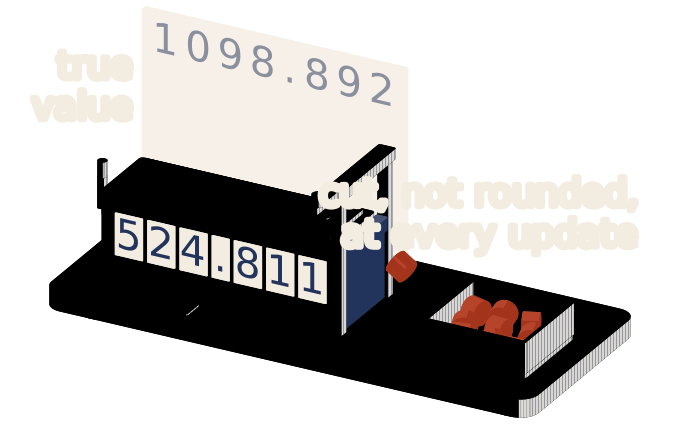
After each of about 3000 daily updates, the exchange’s index was cut to three decimals rather than rounded. It lost about 25 points a month; the 1983 fix took it from 524.811 up to 1098.892.
Vancouver Stock Exchange § Rounding errors on its Index price
Is a chart showing a real problem or just chance? In 1984 Lloyd Nelson published a set of patterns on a control chart that signal something is truly out of control.
20 entries
The turning point
Dorothy Denning proposed that a computer could learn what normal activity looks like and flag whatever strays from it. An anomaly can be fraud, a failure, or simply a recording error.

Computers stored fractional numbers in different, incompatible ways. The 1985 IEEE 754 standard set one exact format and rounding rules, so every machine reads the same bits the same way.
Clocks on networked computers need to agree. The Network Time Protocol, first built and documented in 1985, keeps them synchronised over networks with varying delays.
The Therac-25’s software set a safety flag by counting up, so it could overflow to zero and skip a check. Faults like this caused at least six overdoses from 1985 to 1987; three patients died.

Therac-25; also Integer overflow
On Challenger’s 1985 STS-51-F launch, failing temperature sensors shut down one main engine and almost a second. The mission became the only Shuttle abort after launch.
A component can quietly receive input it was never meant to handle. From 1986, Bertrand Meyer’s design by contract has each part state what it accepts and promises, in checkable terms.
Mailing lists go stale as people move. In 1986 the US Postal Service set up a register of moves so mailers could update addresses before sending.
Most dosimeters at Chernobyl maxed out at 0.001 R/s, so they read ‘off scale’. Trusting the falsely low readings, the crew chief assumed the reactor was intact, and a higher reading was dismissed.
Addresses arrive incomplete and inconsistent. From 1987 the US Postal Service certified software that fixes and matches addresses and fills in a missing city, state or ZIP code.
Filling a missing value with one guess makes data look more certain than it is. Donald Rubin’s 1987 method fills gaps several times and averages the results to account for that.
During Soyuz TM-5’s 1988 descent, solar glare gave the alignment sensors conflicting signals. The computer cut the engine burn early, and the crew had to spend an extra day in orbit.
List of spaceflight-related accidents and incidents; also Soyuz TM-5
Countries write numeric dates differently, so dates get misread when data crosses borders. ISO 8601, first published in 1988, set one unambiguous format for dates and times.
A technician left a hyphen out of one command and sent it before it could be proofread. It switched off the probe’s attitude thrusters, and the spacecraft was lost in 1988.
On approach to Leninakan in 1988, the crew’s incorrect altimeter setting showed them 1,100 m higher than they really were. The Il-76 hit a mountainside, killing 77 of 78.
After rewiring, a loose old wire fed a relay a false signal, so a signal failed to show red with a train ahead. A crowded train hit a stopped one in 1988, killing 35.
Short years are ambiguous across centuries. In 1989 Erik Naggum got a strong recommendation for four-digit years into RFC 1123, the internet host rules.
Broken links between tables can make a database return incomplete results with no error. SQL’s 1989 standard added integrity constraints so the database itself can enforce such rules.
A clerk guessed 60 tons per car when each held about 100, so the train was listed at about 6,151 tons. Too little braking was planned, and it derailed into homes in 1989.
Varig switched to four-digit headings with an unwritten decimal point. The captain read 0270 as 270° instead of 027.0°; the 737 flew far off course, ran out of fuel and crashed, killing 12.
Some mainframes stored dates as a count of days from 1 January 1900, in a number that maxed out at 32,768. On 18 September 1989 the count turned negative and systems failed.
25 entries
After 100 hours running, digits chopped off in the Patriot battery’s time maths had made its clock drift by a third of a second. It searched the wrong sky, and a Scud killed 28 soldiers.

MIM-104 Patriot § Failure at Dhahran; also Floating-point arithmetic
The device used to check Hubble’s mirror had a lens 1.3 mm out of place, so the mirror was polished precisely to the wrong shape. Other tests flagged it but were dismissed.

Typos stop records about the same person from linking. In 1990 William Winkler improved Jaro’s closeness score so names that start the same rank as closer matches.
A crash mid-write can leave files corrupted. In 1990 IBM shipped JFS, which records each change in a journal first, so the disk comes back with less chance of damage.
Soundex often grouped names wrongly. Lawrence Philips’s 1990 Metaphone uses the quirks of English spelling and sound, so names that sound alike get the same key more reliably.
A House study found the 1990 census failed to count two million or more Black Americans. The Commerce Secretary refused to adjust the totals; the national undercount was later put at about 1.6%.
Near Zurich in 1990, a faulty receiver made the captain’s display put the DC-9 roughly 1,000 feet above its real height. The co-pilot’s display was right, but the captain trusted his own. All 46 died.
Files can be corrupted by accident. Ronald Rivest designed MD5 in 1991; no longer safe for security, it’s still used as a checksum to confirm data is intact.
Though the 1991 UK census was compulsory, 572,000 people answered neither the form nor follow-up visits, 220,000 of them men in their twenties. The population was significantly undercounted.
Hansen’s 1991 ‘Zero Defect Data’ framework applied statistical process control, the factory method of tracking quality, to data. MIT’s information quality programme grew out of it.
To give computers one shared way to encode text, the Unicode Consortium was formed on 3 January 1991. It published the first Unicode Standard that October.
Data from many systems arrives inconsistent. Bill Inmon’s 1992 book described the data warehouse: one store where codes are made consistent and bad data is flagged or fixed before reporting.
Final polls had the Conservatives about 1% behind Labour; they won by 7.6%. Inquiries blamed Tory voters declining to answer, poor demographic data and badly chosen sampling spots.
Shy Tory factor § 1992 general election; also Exit poll, Opinion polling for the 1992 United Kingdom general election
Pilots entered ‘33’ meaning a gentle 3.3° descent, but the autopilot was in another mode and flew 3,300 feet per minute down. The A320 hit a mountain in 1992, killing 87.
Worn wiring caused an on-and-off short in the data going to the captain’s attitude display. The faulty readings confused the pilots, and the 737 broke up over the Darién Gap in 1992, killing all 47.
A sensor already found faulty nine times was refitted and set off a false stall warning on take-off at JFK in 1992. The aborted take-off destroyed the jet; 10 were injured.
UTF-8, sketched on a diner placemat on 2 September 1992, lets software start reading anywhere and still find where each character begins. By 2026, 99.1% of webpages used it.
The 1992 SQL standard added CHECK constraints: rules like ‘price >= 0’ that stop an app from storing invalid data, even if the app itself would accept it.
Noise caps how fast data can be sent reliably. Turbo codes, published in 1993, were the first codes usable in practice to come close to that ceiling, the Shannon limit.
From 18 September 1993, Sierra games on the Mac froze. A delay calculation that divided the date overflowed, the software carried on as if it had worked, and a one-second pause became 18 hours.
Five cells in the Pentium’s division lookup table held zero instead of +2, so some divisions came out wrong. Intel booked a $475 million charge to replace the chips.

In 1994 Masahiro Hara of Denso Wave invented the QR code to label car parts. Built-in error correction lets a scanner recover the data from an imperfect image.
Named in 1994, Skadi Mons was thought for 31 years to be Venus’s highest peak. A 2025 analysis of the terrain data found no mountain, and the name was dropped.
Official numbers can be misread. The UN’s ten principles for national statistics, agreed in 1994, include letting statisticians speak up when their data is wrongly interpreted.
A short circuit lit a false low-oil-pressure warning. The crew took falling pressure from the engine they had throttled back as confirmation, lost control going around, and 3 died.
35 entries
One program reported thruster impulse in imperial units; the navigation software read them as metric, so the figures were 4.45 times off. The orbiter came in too low in 1999 and was lost.
$327.6 million (orbiter and lander project)

Mars Climate Orbiter § Cause of failure; also Unit of measurement, Metrication
Data can get corrupted when stored or sent. Mark Adler’s 1995 checksum, a variant of Fletcher’s, lets the widely used zlib library check that data arrived intact.
In 1995 an accountant at Fidelity left the minus sign off a $1.3 billion net capital loss. A loss became a gain, and the books were out by $2.6 billion.
The DC-9’s main altimeter was wrongly set and read 16,200 ft as it hit the ground in 1995. The backup worked, but its lights had failed, so the crew couldn’t compare. 51 died.
Norway warned Russia about a research rocket launch, but the notice never reached radar operators. They read it as a possible submarine missile, and Yeltsin was handed the nuclear briefcase.
Organisations can hold incomplete or inaccurate data about people. The EU’s 1995 Data Protection Directive gave people the right to demand it be corrected.
As pressure fell fast near Hartford in 1995, the crew had 29.23 set when the right value was 29.15. Flying too low, the MD-83 hit trees and an antenna, causing $9 million damage.
The crew’s chart called the Rozo beacon ‘R’, but the flight computer’s database named it ‘ROZO’. Selecting ‘R’ picked a beacon near Bogotá, and the jet turned into a mountain, killing 159.
Odd points can hide in a big dataset. DBSCAN, proposed in 1996, groups points packed closely together and marks the ones sitting alone as outliers.
One pitot tube was likely clogged by a wasp nest, feeding false airspeed to the captain and autopilot. Pilot error followed, and the 757 crashed in 1996, killing all 189.
AOL’s profanity filter spotted a rude word hidden inside the name Scunthorpe and stopped residents opening accounts in 1996. Such false matches are now called the Scunthorpe problem.
Ariane 5 reused Ariane 4 code that squeezed a velocity value into a 16-bit integer. Ariane 5 flew faster, the value overflowed, and the rocket self-destructed in 1996, costing over US$370 million.

Ariane flight V88 § Launch failure; also Integer overflow, List of software bugs
A worker left tape over the air pressure ports after maintenance, so the cockpit showed wrong speed and altitude. Amid a flood of unreliable warnings, the 757 hit the Pacific in 1996, killing 70.
The control computers at two aluminium smelters weren’t programmed for a 366th day. At midnight on 31 December 1996 all 660 shut down; repairs cost over NZ$1 million.
To treat digital records like paper ones, the FDA’s 1997 Part 11 rule requires audit trails and validated systems before drug and device makers’ electronic data counts as trustworthy.
Account numbers get mistyped. The IBAN, an international standard since 1997, includes two check digits so the number can be verified before a transfer goes through.
In 1997 a credit card expiring in 2000 crashed a grocer’s 10 cash registers again and again. It led to the first Y2K lawsuit, over computers that couldn’t handle the year 2000.
Guam’s glideslope, a beam that guides planes down, wasn’t working, but the captain locked onto a signal from an unrelated ground device. With a safety alarm switched off, the 747 crashed, killing 229.
Someone on board entered a zero in a database, which led to a division by zero. Every computer on the ship’s network went down, and USS Yorktown lost propulsion for hours in 1997.
Ice in the DC-9’s pitot tube made airspeed read too low. The crew extended the slats at too high a speed, one tore off, and the plane crashed in Uruguay in 1997, killing all 74.
Apollo’s Domain/OS counted time in 4-microsecond steps from 1 January 1980 in a 48-bit number. On 2 November 1997 it overflowed, leaving unpatched machines unusable.
In 1998 a computer upgrade meant to prevent the Y2K date glitch led an electric company to send Oswego, a village in Illinois, a $7 million bill by mistake.
In 1998 Consumer Reports said Iams dog food lacked nutrients, then took it back. It blamed a systemic error in measuring potassium, calcium and magnesium.
Command errors left SOHO’s fault-detection gyro on its sensitive setting, so it reported a roll 20 times faster than real. Thrusters fought the phantom spin, and contact was lost for weeks.
Solar and Heliospheric Observatory § Near loss of SOHO in 1998
Fujitsu’s Horizon system showed cash shortfalls caused by its own faults. From 1999 to 2015, over 900 UK subpostmasters were wrongly convicted on its data; at least thirteen suicides were linked.

Testing for Y2K in 1999, a technician changed the date on the live, not-yet-upgraded computer instead of the test one. Every computer at the nuclear station crashed for about seven hours.
The anti-ice heating for the airspeed probes was probably never switched on. The crew didn’t see why speed readings went erratic, and the 737 crashed eight minutes after take-off, killing 6.
Told to climb to 1,500 metres, the crew took it as 1,500 feet, thought they were too high and descended. The MD-11 crashed in Shanghai in 1999, killing 3 crew and 5 on the ground.
8 killed
Korean Air Cargo Flight 6316 § Investigation; also Unit of measurement
A value was entered wrongly into the rocket stage’s guidance database, so it ignored roll data from its gyro. The stage tumbled, leaving a Milstar satellite in a useless orbit in 1999.
GPS broadcasts the week number in a ten-bit counter that tops out at 1,023 and then resets to zero. The first reset, on 21 August 1999, caused only minor disruption.
Old programs used 9/9/99 to mean ‘unknown date’ or ‘end of data’. When 9 September 1999 actually arrived, accounts differ: some say systems crashed, others that it mostly confused operators.
Time formatting and storage bugs § 9/9/99; also Year 2000 problem
A blocked pitot drain made the MD-11’s airspeed read 12 knots slower than real. The crew didn’t respond properly, and the freighter crashed on landing at Subic Bay in 1999.
Vibrations from the legs unfolding looked to the software like touchdown. The review board found it likely cut the engines about 40 metres above Mars, and the lander was lost.
US$165 million
A partly failed navigation unit gave the captain’s artificial horizon wrong roll information. After take-off from Stansted in 1999, the 747 freighter rolled into a forest, killing all four crew.
2000 to 2014
29 entries
Switzerland and Germany measure height from different seas, 270 mm apart. Engineers planned for it, but a sign error doubled the gap to 540 mm instead of cancelling it.

The LOF algorithm flags a data point as odd when it sits in a much emptier spot than the points around it, catching anomalies a single global rule would miss.
A stall warning sounded at take-off though the plane wasn’t stalling. The crew’s response sent the A310 into the sea off Abidjan in 2000, killing 169. The alarm’s cause was never found.
Florida’s contractor flagged voters as felons on as little as an 80% name match, even with first and last names swapped. In May 2000 it found about 8,000 names wrongly on the exclusion list.
Florida Central Voter File § Problems in the cleansing process
Staff entered five shielding blocks into planning software as if they were one, and one way of doing it made the software set far too long a treatment. 28 patients were overdosed and eight died.
Multidata’s radiation planning software could wrongly double the dose depending on how a technician entered data. Eight or more patients died and 20 more were overdosed.
On 31 December 2000, all 29 of Norway’s new Signatur trains refused to run: their computers treated the year’s 366th day as invalid. Engineers set the clocks back a month.
Year 2000 problem § On 31 December 2000, or 1 January 2001; also Leap year problem
A two-sentence add-on to a 2001 US spending bill told federal agencies to ensure the quality, objectivity, usefulness and integrity of the information they publish.
About 3000 Oregon residents were called for jury duty on dates in 1901. Staff typed only two-digit years, so nobody noticed the computer had rolled the year over wrongly.
Documents passed between programs need to follow agreed rules. XML Schema, a W3C recommendation since May 2001, spells out those rules so software can reject a document that breaks them.
Officials searched for Vivian Solon under her middle name, found no record, and removed the Australian citizen to the Philippines in 2001. Eleven different spellings of her name added to the confusion.
Some systems stored time as seconds since a fixed start date in a nine-digit string. On 9 September 2001 the count passed one billion; problems were not widespread.
A UBS trader meant to sell 16 Dentsu shares at ¥600,000 each in 2001 but sold 610,000 shares at ¥6. The exchange didn’t cancel the trades, and the bank took the loss.
US$100 million
The same person spelled differently on old electoral rolls is hard to link. In 2002 David Hood made a sound-based code to match those names in New Zealand records.
The 2002 Sarbanes–Oxley Act set out to make company disclosures more accurate and reliable. Top executives must personally certify that the financial figures are correct.
Data on disks can get corrupted. In 2003 the T10 committee proposed the Data Integrity Field to protect stored data, and NVMe drives added a similar approach in 2016.
A 2003 US law, FACTA, let consumers get their credit report free from each agency once a year, a chance to check what’s recorded about them.
Fair Credit Reporting Act § Inaccuracies in consumer reports
A cut-and-paste error in a spreadsheet led TransAlta to buy more US power transmission contracts, at higher prices, than it meant to in 2003. It lost $24 million.
A bug in some Motorola GPS receivers threw one timestamp a day off if no leap second had been scheduled for 256 weeks. On 28 November 2003 they briefly showed 29 November.
German citizen Khaled El-Masri was detained in Macedonia in 2003 and handed to the CIA, partly because his name matched a wanted al-Qaeda suspect’s, apart from spelling in Roman letters.
Germany’s A2LL software for unemployment and social benefits had errors with large-scale effects, including paying money in 2004 to account numbers that weren’t valid.
Windows sometimes guessed a plain text file’s encoding wrongly, so Notepad showed a file reading ‘Bush hid the facts’ as Chinese characters. The bug dated from 1994 and was found in 2004.
Some check-digit schemes need a non-digit like X. H. Michael Damm’s 2004 algorithm catches every single-digit slip and every swap of neighbours with only ten possible check values.
Eurostat repeatedly refused to accept Greece’s fiscal data, and a 2004 audit revisited it. A reported surplus turned into a deficit, and the bad data made growth and debt impossible to predict.
2004 Greek financial audit; also Greek government-debt crisis
An FBI database search for a Madrid bombing fingerprint returned twenty possible matches, including lawyer Brandon Mayfield. On that faulty match he was arrested in 2004 and held for two weeks.
Ted Kennedy said he was repeatedly delayed at airports because ‘T Kennedy’, a suspect’s alias, was listed on the government’s No Fly List. About 7,000 American men share that name. An ex-official later disputed it.
The capsule’s deceleration sensor was designed backwards, so it never detected the 3 g that should trigger the parachutes. The capsule crashed in Utah in 2004, contaminating many samples.
Disks can silently corrupt data through power surges, firmware bugs or misdirected writes. ZFS, announced in 2004, checksums every block and repairs bad data from redundant copies.
In 2004 London’s Horniman Museum was missing some of its email: spam filters mistook its name for the words ‘horny man’.
37 entries
In 2005 a Mizuho employee keyed in a sale of 600,000 J-Com shares at ¥1 instead of one share for ¥600,000. Mizuho took a huge loss, and the exchange chief resigned.
about ¥40.7 billion

Tokyo Stock Exchange § Technology problems; also Mizuho Securities, Fat-finger error
Navigation failures left DART approaching its target without accurate distance data, and its collision-avoidance system relied on wrong position and speed. It bumped the satellite, ending the US$110 million mission.
The Data Quality Campaign, a US nonprofit launched in 2005, pushes to make education data more accurate, easier to reach and better used.
From 2005 to 2019, about 26,000 Dutch parents were falsely accused of benefit fraud. Small slips, like a missing signature, could mean repaying everything, and nationality drew unwarranted scrutiny.
By November 2005, some 30,000 people had complained that airline software matched their names to the No Fly List. Even babies under one triggered false matches.
In 2005 France’s privacy regulator found errors in 47% of records in the STIC police database. Some people listed, sometimes wrongly, couldn’t find jobs.
Near Guam in 2005, USS San Francisco hit an undersea mountain at top speed. Its chart didn’t show it, though other charts hinted at one. One sailor died and ninety-eight were injured.
Testimony about the Sedan nuclear test was typed as ‘Sudan’ in the 2005 Congressional Record. Sudan’s government kept investigating even after the US embassy called it a typo.
During start-up at BP’s Texas City refinery in 2005, the tower’s level gauge was uncalibrated and unreliable, and a backup alarm failed. The tower overfilled, and the explosion killed 15.
A hidden software error let the 777’s navigation unit trust readings from a broken accelerometer. The plane made moves nobody commanded, but the crew flew it by hand to a safe landing in Perth.
Air data inertial reference unit § Malaysia Airlines Flight 124
In 2005 someone at Kodak typed too many zeros into one employee’s severance by hand, creating an $11 million error.
Crosscheck flagged voters in different states as possible duplicates when name and birth date matched, even if their Social Security digits didn’t. The loose matching produced many false positives.
Tank 912’s level gauge froze on one reading while petrol poured in, and a high-level switch apparently failed. The tank overflowed in 2005, and the vapour exploded, injuring 43.
A Horizon software error showed a £48,000 hole in Noel Thomas’s accounts. Found guilty in 2006 of false accounting, he served 13 weeks in jail before the conviction was overturned.
AOLserver set ‘never’ timeouts a billion seconds ahead. From 13 May 2006 that landed past its 2038 limit, so dates wrapped into the past and the software crashed.
Two operators updated separate copies of Mars Global Surveyor’s software with different values. A fix sent later carried a memory fault, and NASA lost the spacecraft in 2006.
Six F-22s flying from Hawaii to Japan in 2007 suffered computer crashes as they crossed the International Date Line, losing navigation and communication. They followed their tankers home.
List of software bugs § Military; also Lockheed Martin F-22 Raptor
A 2005 US law moved daylight saving dates from 2007, so systems needed updating to show the right time. Preparation prevented major trouble, but isolated glitches hit Google AdWords and Windows users.
A 1997 attempt to merge three pension databases left records for 50 million payers unmatched to anyone in the system. Exposed in 2007, the scandal partly cost the ruling party an election.
Sierra’s patch for its Mac games subtracted 432,000,000 seconds before the same date division. On 28 May 2007 the sum overflowed again and the patched games froze.
Many phones in Turkey replaced the dotless ‘ı’ with a plain ‘i’, sometimes badly changing a message’s meaning. One such miscommunication played a part in deaths in 2008.
In 2008 Facebook suspended Hiroko Yoda’s account because her surname, common in Japan, was confused with the name of a Star Wars character.
Instead of modelling normal data, isolation forest splits the data at random. Rare, very different points get cut off fastest, so they are the ones it flags.
Skipping checklist steps, the crew never started the ATR 42’s attitude and heading system before take-off. Disoriented among mountains near Mérida in 2008, they crashed, killing 46.
Heavy rain got moisture into a B-2’s air-data sensors, so the airspeed shown was wrong and it lifted off too slowly on Guam in 2008. Both crew ejected.
US$1.4 billion
A prison clerk wrongly recorded US-born Mark Lyttle’s birthplace as Mexico. Immigration officers then built a case on that entry, ignoring FBI fingerprint records showing he was a citizen, and he was deported in 2008.
Google Maps showed Argleton, a settlement in empty Lancashire fields. Services that reused the data placed real businesses there and gave it weather reports, until Google removed it by May 2010.
A faulty unit relabelled the plane’s altitude, 37,012, so it read as a 50.625° angle of attack. Flight computers pushed the nose down twice in 2008, injuring 119.
Water let in during maintenance froze inside the A320’s angle-of-attack sensors, so they stopped working. During a low-altitude test in 2008, the plane crashed off France, killing all seven.
7 killed
At midnight on 31 December 2008, many Zune 30 players froze because their clock software mishandled the leap year’s last day. They recovered by themselves 24 hours later.
Zune 30; also Leap year problem
ISO 8000 gives organisations one shared international benchmark for the quality of their data, including master data. Proposed in 2002, its first parts were approved in 2009, building on NATO’s system for describing products.
On 31 January 2009 someone accidentally added ‘/‘, a pattern matching every web address, to Google’s malware list. For about 40 minutes every search result was flagged as harmful.
On approach to Amsterdam in 2009, the captain’s radio altimeter suddenly read −8 feet instead of 1,950. The autothrottle cut power to idle, and the 737 stalled and crashed, killing nine.
The first officer entered 262.9 tonnes when the A340 weighed 362.9, so the engines got too little thrust. In 2009 the jet hit structures past the Melbourne runway before landing safely.
Ice crystals likely blocked the pitot tubes, so indicated airspeed dropped from 274 to 52 knots and the autopilot switched off. The crew stalled the plane into the Atlantic in 2009, killing all 228.

After a part was replaced, a track circuit couldn’t reliably detect when a train was on its section. In 2009 a Red Line train ran into a stopped one, killing nine.
The Data Management Association’s 2009 Body of Knowledge set out how to manage data, with governance at the centre and quality among its core topics.
Data Management Association § Data Management Body of Knowledge
35 entries
Critics found the spreadsheet behind a paper widely cited for austerity left out several countries. With that and two disputed choices corrected, average growth above 90% debt was 2.2%, not −0.1%.

Growth in a Time of Debt § Methodological criticism; also Spreadsheet
In 2010 a formatting error in a spreadsheet changed the last three digits of phone numbers to 000. MI5 ended up wrongly gathering data on the subscribers of 134 numbers.
Missing values often get converted to zero, so bad records land at latitude 0, longitude 0. Around 2010 map data named that point Null Island, making them easier to find and fix.

A faulty number conversion in Bank of Queensland’s payment terminals made them skip from 2010 to 2016. They declined cards as expired, and many were out of action for as long as a week.
Some systems confused BCD and hexadecimal, different ways of encoding numbers, when the year reached 2010. In Germany over 20 million bank cards stopped working, and some phones dated texts 2016.
Nurses could accidentally switch scales between imperial and metric and give the wrong dose. In March 2010 the Department of Health told NHS trusts to use metric-only scales.
Metrication in the United Kingdom § Metric-only scales in the NHS (2010)
On 1 March 2010, a date-storage bug made many original PlayStation 3s think 2010 had a leap day. Clocks reset to 31 December 1999, and users couldn’t sign in or play.
In a key safety test, staff accepted a ‘no flow’ reading from one line and ignored a 1,400-psi reading on another. The well blew out in 2010, killing 11 workers.
Horizon showed Seema Misra’s branch over £70,000 short when no money was missing, and she was jailed while pregnant. Before her 2010 trial, Post Office lawyers learned of a Horizon bug but didn’t disclose it.
When some countries changed to or from daylight saving time in late 2010, repeating alarms on iOS 4 rang an hour early or an hour late.
Messy tables are full of the same value written many ways. Google Refine, released in 2010 and now OpenRefine, groups and fixes them with filters and clustering.
Bangladesh’s 2011 census counted 144.0 million people. The statistics bureau later estimated the real population was about 149.8 million, so millions were missed.
In early Minecraft, small errors in decimal maths grew the further players went from the centre, until the terrain became a corrupted wall known as the Far Lands.
CERN’s OPERA experiment measured neutrinos in 2011 that seemed to beat the speed of light. The cause: a badly plugged-in fibre optic cable, plus a clock ticking too fast.
List of experimental errors and frauds in physics § Famous experimental errors
Taiwan’s official calendar counts from 1912, so 2011 was year 100, trouble for programs storing two-digit years. Most systems were ready, though some iPhone alarms failed.
The rocket carrying NASA’s US$424 million Glory satellite failed in 2011. Investigators traced it to faulty aluminium from a supplier that had falsified thousands of test certificates.
Faulty signals failed to warn a high-speed train of a stopped train ahead at Wenzhou in 2011; one device never switched from green to red. 40 people died.
Voter rolls fill up with people who have moved, died or registered twice. In 2012 seven states launched ERIC to share data and find those records.
JPMorgan’s investment office lost over US$6 billion in 2012. Spreadsheet miscalculations led to big errors in how positions were valued, and its risk model was miscalculated.
2012 JPMorgan Chase trading loss § Investigation; also List of spreadsheet mistakes
Microsoft Azure’s virtual machines crashed at startup in 2012. A calculation of the date ‘one year from now’ changed the year but kept the day, which broke on the leap day.
After the leap second added on 30 June 2012, flawed software caused problems at Reddit, Mozilla, Qantas and various Linux-based sites.
Financial institutions couldn’t reliably tell organisations apart across countries. The G20 created the Legal Entity Identifier, and the first ones went out in December 2012.
Google Flu Trends guessed flu levels from searches, but many searchers may not have had flu. It missed the 2009 pandemic and once predicted twice the doctor visits the CDC recorded.
To judge whether data can be trusted, you need its history. The W3C’s 2013 PROV standard records the sources, steps and people behind data, so errors can be traced to their cause.
The Basel Committee’s 2013 BCBS 239 sets principles for how banks gather and report risk data, applying to the biggest global banks from 2016.
As 2012 became 2013, iPhones’ Do Not Disturb stayed on past schedule because of a formatting difference between calendar systems. It fixed itself on 7 January 2013.
USS Guardian’s digital chart put Tubbataha Reef about 7.8 nautical miles from its true spot. The error was known since 2011 but never fixed on that chart, and the ship ran aground in 2013.
US$1.97 million paid to the Philippines
Three of a Proton-M rocket’s yaw sensors, backups included, were installed the wrong way round. With no yaw control, it failed shortly after lift-off in 2013.
Deep Impact apparently counted time in tenths of seconds from 1 January 2000, in a 32-bit number. On 11 August 2013 it overflowed, the computers kept rebooting, and contact was lost.
Deep Impact (spacecraft); also Time formatting and storage bugs
A Japanese broker mistakenly placed share orders in 2014 worth over US$600bn, in companies like Toyota, Honda and Nomura. The orders were cancelled.
To appear to meet a 14-day target, staff at some VA hospitals falsified appointment records. In 2014 CNN reported at least 40 veterans died waiting for care in Phoenix.
Data can break anywhere as it moves through pipelines. DataOps, named by Lenny Liebmann in 2014, uses statistical process control to monitor that flow and alert the team when something looks off.
Ice crystals probably blocked the engine pressure sensors, giving wrong readings that made the autothrottle cut thrust. The plane slowed, stalled at altitude and crashed in Mali in 2014, killing all 116.
Team Vestas Wind’s route-planning screen didn’t show a coral atoll unless the crew zoomed in close. In 2014 the race yacht ran aground on it at night.
In 2014 Gangnam Style passed 2,147,483,647 views, the most YouTube’s 32-bit counter could hold. YouTube had to switch to 64-bit numbers to keep counting.
2015 to today
41 entries
Maarten Masschelein and Tom Baeyens start Soda in Brussels with one idea: check data continuously, so a wrong unit or a missing row fails a test before anyone builds on it.

Innoviris (Brussels-Capital Region), founder profile of Maarten Masschelein
A 2015 study of 1,151 children said religious kids were less generous. Country had been coded as a number on a scale, not a category; corrected, the religion finding vanished and the study was retracted.
In 2015 a junior Deutsche Bank employee mixed up the gross and net figures on a trade and paid a US hedge fund US$6bn, far too much. The bank got it back the next day.
Facebook blocked names with too many capital letters, so genuine Scottish Gaelic surnames like NicIllAnndrais were still not allowed in 2015.
Software bugs around the 2015 leap second caused some router failures and brief outages at Twitter, Instagram, Netflix, Amazon and others, and reportedly hit an airline booking system.
People measured medicine with kitchen spoons and mixed up ‘tsp’ and ‘tbsp’. In 2015 US paediatricians called for millilitre-only dosing with a proper measuring device.
None of the 92 qualifying polls predicted the Conservatives’ 6.5% lead over Labour in 2015. An inquiry found the main cause was unrepresentative samples, not shy voters.
Many lorry drivers didn’t understand height signs in feet and inches, a factor implicated in bridge strikes; over 1,600 hit rail bridges in 2014/15. From 2015, new signs had to show metric too.
Metrication in the United Kingdom § Example of accidents, costs and wastage
The Boeing 787 counted uptime in hundredths of seconds in a 32-bit number that would run out after 248 days, crashing its power controls. In 2015 the FAA ordered regular resets.
Time formatting and storage bugs § Boeing; also Integer overflow
In May 2015 an A400M crashed near Seville after three engines got stuck at one power setting. Investigators’ main theory: calibration data was accidentally erased while engine software was installed.
Nurses at the Princess of Wales Hospital were accused of negligence, but in 2015 the prosecutions collapsed when the electronic log of patient records proved unreliable.
BNP Paribas posted a price of €108.80 for securities it says were worth €54,312 each. A trader bought 3,000, and the bank missed the error for days, leading to a long lawsuit.
Armin S. § Lawsuits filed against BNP Paribas; also Fat-finger error
dbt began at RJMetrics in 2016 so analysts could transform warehouse data with SQL while following software engineering’s best practices.
Excel automatically converts gene names like MARCH1 and SEPT2 into dates. A 2016 study found such errors in 19.6% of papers whose Excel gene lists it checked.
Microsoft Excel § Conversion problems; also List of spreadsheet mistakes
The FAIR principles, formally published in 2016, ask that data be findable, accessible, interoperable and reusable, so others can actually locate and use it.
Forecasts missed Trump’s strength in key Midwestern states in 2016. A 2018 study blamed a late swing and polls failing to correct for having too many college graduates in their samples.
2016 United States presidential election § Election forecasts; also Opinion poll
A faulty inertial reference unit showed wrong attitude information on one pilot’s display. The CRJ200 cargo plane crashed in Norway in 2016, killing both crew.
On 29 February 2016, a bug in Düsseldorf Airport’s baggage conveyors couldn’t cope with the leap day, and over 1200 bags missed their flights.
Hitomi’s rotation sensor reported a 21.7° per hour turn while the satellite was steady. Its controls fought the phantom spin, a wrong software setting made it worse, and it broke apart in 2016.
The EU’s GDPR, adopted in 2016 and in force from 25 May 2018, lists accuracy as a core principle for handling personal data, alongside keeping only what’s needed.
Australia’s Robodebt compared welfare records with averaged tax-office income to issue debts automatically. Ruled unlawful, it saw 470,000 wrong debts repaid and a settlement worth A$1.8 billion.
In 2016 an overflow bug made a casino machine print a ticket for $42,949,672.76. The casino refused to pay, and New York’s gaming commission sided with it.
Advising on Tesla’s 2016 purchase of SolarCity, Lazard double-counted a figure in its cash flow analysis, undervaluing SolarCity by $400 million.
A rotation sensor maxed out for about a second, and combined with navigation data it gave a negative altitude. Schiaparelli released its parachute early and hit Mars at 300 km/h in 2016.
In 2017 ISO released a data governance framework: the rules and accountability organisations put around their data, often to improve its quality or to meet regulations.
New York City spent $27.5 million on McKinsey from 2014 to 2017 to cut violence at Rikers Island. Alleged failings included spreadsheet mistakes that made the starting violence rate look higher than it was.
In June 2017 BPI, a Philippine bank, shut online and ATM services after money vanished from accounts. It blamed an internal error in processing data that had doubled some transactions.
In 2018 Deutsche Bank accidentally moved 28 billion euros into an outside account, a sum larger than the whole bank’s market value.
Long-settled Caribbean-born residents often had no official record of arriving, and the landing cards logging arrivals were destroyed in 2010. In 2018 it emerged many were wrongly detained, and at least 83 deported.
With pitot heating off, all three airspeed probes iced up and gave conflicting readings. Chasing a speed loss that wasn’t real, the captain dived; all 71 aboard died in 2018.
A failed air data unit made the 737 pitch up and climb 600 feet. Even in backup mode it kept showing the captain wrong attitude, so the crew flew by hand and landed.
A wrongly calibrated angle-of-attack sensor fed bad data to MCAS, a system that relied on that one sensor. It kept pushing the 737 MAX’s nose down until it crashed in 2018, killing 189.

Final polls in Australia’s 2019 election were suspiciously close to each other and got the winner wrong. Later modelling suggested pollsters had ‘herded’ toward each other rather than sampled badly.
In 2019 Zhamak Dehghani defined data mesh: each team publishes its data as a product that others can find and trust, governed by shared standards.
After Japan’s 2019 change of imperial era, Lawson store ATMs said deposits wouldn’t clear until May 7, 1989. A date conversion used the old era’s first year instead of the new one’s.
A 2014 study claimed anti-gay prejudice cut sexual minorities’ lives short by 12 years. A data coding error turned up; corrected, the link wasn’t significant, and the paper was retracted in 2019.
Right after take-off in 2019, the plane’s angle-of-attack sensors disagreed by 59°. MCAS acted on the bad reading, pushing the nose down repeatedly, and the 737 MAX crashed, killing 157.
In April 2019 GPS’s week counter reset to zero again. Unpatched Honeywell flight software delayed a KLM flight and cancelled many in China, and New York City’s municipal wireless network crashed.
National copies of the kilogram drifted by up to 20 μg a year against the master. In 2019 four base units, the kilogram among them, were redefined using fixed constants of nature.
Burmese text typed with the Zawgyi font came out garbled for Unicode users, and the other way round. Myanmar’s government made 1 October 2019 ‘U-Day’ to switch officially to Unicode.
7 entries
Public Health England’s pipeline hit an Excel size limit, so 15,841 positive tests were left out of daily figures and contact tracing for about a week. Economists estimated 1,500 deaths; PHE disputed it.

Public Health England § Handling of test results; also History of the COVID-19 pandemic in the United Kingdom, NHS Test and Trace, Spreadsheet, List of spreadsheet mistakes
In 2020 Suunto sports watches got the day of the week wrong, showing days two ahead of the real ones, such as Friday on a Wednesday.
Bureau checks found the 2020 census significantly off in 14 states, by between 1.5% and 6.6%, and likely undercounted Hispanic and Black residents. Congressional seats based on it are not adjusted.
List of U.S. states and territories by population; also 2020 United States census
Many Y2K fixes read two-digit years 20 to 99 as 1920 to 1999. So 2020 brought new failures: New York parking meters refused cards, bills showed 1920, and a video game crashed.
Year 2000 problem § Since 2000; also Time formatting and storage bugs
Major COVID-19 studies used patient datasets from Surgisphere that turned out to be unreliable. The WHO paused hydroxychloroquine trials over them; the studies were retracted and the trials resumed.
In May 2020 a wallpaper sent some Android phones into endless restarts. Converting it between colour formats left a pixel with an impossible colour value, which the system then tried to show.
Spreadsheets kept turning gene names into dates. In August 2020 geneticists issued new naming rules and renamed 27 genes, so MARCH1 became MARCHF1 and SEPT1 became SEPTIN1.
5 entries
Soda’s first open-source tool: data engineers profile, test and monitor SQL tables with a few lines of YAML, instead of homegrown scripts.

In 2021 scientists heading for Oodaaq landed 780 metres away because of a GPS error. Believing they’d found an unknown island, they announced Qeqertaq Avannarleq.
Predictive monitoring plus simple rules, so data engineers and business experts catch silent data issues together, before they spread.
Welcome Soda Cloud: End-to-End Data Observability and Collaboration (soda.io blog, Jun 10, 2021)
In 2021 a manual entry mistake at Crypto.com turned a $100 refund into a transfer of $10.47 million.
A data contract spells out what data producers promise the people using their data: the schema, quality rules and service levels. In 2021 Andrew Jones described how GoCardless was using them.
6 entries
Open-source checks that run wherever data moves, from ingestion to transformation to the dashboard that uses it.

Introducing Soda Core: The New Way for Data Reliability (soda.io blog, Jun 28, 2022)
Honda and Acura cars built from 2004 to 2012 with GPS navigation showed 2022 as 2002, because a GPS date counter overflowed. The problem cleared up on 17 August 2022.
Time formatting and storage bugs § Year 2022; also GPS week number rollover
Exchange’s malware scanner stored update dates like 2201010001 in a number capped at 2147483647. On 1 January 2022 it failed, and emails got stuck in queues.
Year 2000 problem § Year 2022 problem; also Year 2038 problem
A plain, readable language for data quality checks, so anyone can write one, not just engineers fluent in SQL.
Introducing a New Domain-Specific Language for Data Reliability (soda.io blog, Feb 24, 2022)
Dean Baker estimated a US minimum wage tied to productivity at about $24 an hour. Once a spreadsheet mistake was spotted in 2022, the figure was revised to $21.50.
A Citigroup trader in London made an input error that sent a huge sell order. In 2022 Nordic stock indices fell by up to 7.5% in minutes before rebounding.
Flash crash § Flash Crash of European Stock Markets on May 2, 2022
8 entries
Producers publish what their data promises, an API for data, and Soda verifies every new batch against it.

Release notes for Soda products (docs.soda.io, 16 November 2023)
Ask for a check in a sentence and get it written for you, opening data quality to people who don’t code.
Soda raised $14 million for its AI-driven data quality tools (Tech.eu, 11 July 2024)
The US kept a separate survey foot alongside the international one. NIST phased it out on 1 January 2023, leaving the international foot of exactly 0.3048 metres for everything.
Hakuto-R’s computer wrongly decided its radar altimeter was broken and ignored it. Misjudging its height, it hovered about 5 km up, then crashed on the Moon in 2023.
Check templates, suggested checks and group-by checks on top of Soda Core.
In 2023 the Linux Foundation’s Bitol project published version one of the Open Data Contract Standard, building on PayPal’s open-sourced template, so teams can write data contracts the same way.
New Zealand’s Electoral Commission admitted data entry errors at 15 voting places in 2023 left over 700 votes out of the count and gave hundreds to the wrong parties.
Business users create data quality checks right in Soda Cloud, without writing a line of code.
Release notes for Soda products (docs.soda.io, 07 December 2023)
6 entries
A machine-learning dashboard watches every dataset’s basic quality metrics and flags anomalies, with no rules to write. Denning’s 1986 idea, on every table.

On flight 72 in 2024, Ingenuity’s camera navigation couldn’t spot enough ground features to follow over smooth sand. Without accurate data, it landed hard and broke its rotor blades.
A safety switch on Odysseus’s laser rangefinder was never turned on before launch. Without altitude readings it landed too fast on a slope in 2024, broke a leg and tipped over.
In 2024 self-service payment machines at fuel pumps across New Zealand couldn’t handle the leap day, and pay-at-pump stations were down for over 10 hours.
Leap year problem § Occurrences; also Time formatting and storage bugs
Generative AI writes the SQL and regex behind checks and answers questions inside Soda Cloud.
An overflow bug lurking for 30 years surfaced in December 2024 in every version of HCL Notes. Servers started from 13 December couldn’t load mail routing, so no mail was delivered.
7 entries
Data producers and consumers agree on expectations in one shared contract, in code or no-code, and stop bad data before production.

The World's First Collaborative Data Contracts (soda.io blog, Jun 11, 2025)
California’s guide for the November 2025 special election mislabelled one congressional district. Eight million copies had gone out before anyone noticed, so voters were sent correction postcards.
2025 California Proposition 50 § Voter information guide error
On 1 January 2025 every Talgo AVRIL train in Spain stopped because the battery charging module mishandled the date. Delays and cancellations lasted until a fix the next day.
ML model monitoring joins Soda, so one platform follows data quality from ingestion all the way to automated decisions.
Soda has acquired ML monitoring startup NannyML (soda.io blog, Jun 9, 2025)
Adaptive AI monitoring of metrics, launched as Soda’s fastest and most accurate observability yet.
An Angara Airlines An-24 crashed in Russia’s Amur region on its second landing try in poor visibility in 2025, killing all 48. Investigators blamed an incorrect altimeter setting.
Fact-checkers found the book Empire of AI overstated a Chilean datacenter’s water use 1,000 times over because of a unit conversion error. Author Karen Hao acknowledged it in 2025.
4 entries
Every table gets a contract: AI drafts it and observability runs automatically. Contract Autopilot ships in private preview.

From detecting bad data to fixing it: AI agents propose corrections, data stewards approve them, and the fixes write back to the source.
Introducing Soda Cleanse: From Detection to Remediation (soda.io blog, Apr 16, 2026)
Data contracts run from a pipeline CLI, an API, or AI assistants like Claude and Cursor through MCP.
CLI, API, or MCP? Pick the right way to use Soda for the job (soda.io blog, Jul 3, 2026)
A replacement power supply in Telstra’s network read the GPS date as 2006 when it started up. The result, on 8 July 2026, was a nationwide outage across Australia.
Next · Tuesday, November 17
For thousands of years, bad data was found after the damage was done. A ship sank, a probe was lost, a poll called the wrong winner, and only then did someone go back to the numbers. It doesn’t have to work that way anymore. On November 17, our co-founder Hakim shows, live from New York, how data teams can catch an issue as it happens, see why it happened, and fix it where it started.
10:00 ET / 16:00 CET · 45 minutes
Online, or in person in New York